Sight-reading is usually treated as a mysterious talent, but it’s really just a mechanical skill. To actually improve at it, you need a carefully chosen repertoire designed to train your eyes and hands, scaled by the actual patterns that show up in classical literature rather than vague pedagogical ideas.
We read music for two reasons: either to quickly sketch out a piece out of curiosity, or to play it fluently without the exhausting effort that ruins the music. To play fluently, you have to become intimately familiar with the most common instrumental and compositional patterns.
Recognizing Patterns
Reading basically boils down to three things: rhythmic patterns, tonal patterns, and instrumental patterns. A pattern is just a group of signs—a rhythm, a chord shape, a specific technique—that repeats enough to have an instant visual identity on the page.
When we look at a score, we don’t read individual notes; we read shapes. Rhythmic and instrumental patterns (like the broad arc of an arpeggio or the vertical block of a chord) register in our brains way before tonal patterns do. It’s easy to get confused by a dense chord or a tricky key signature, but your eye instantly catches the physical shape of the music.
Tonal patterns only really click once you’ve studied harmony and internalized them through solfège and singing. Because of that, actually executing those tonal patterns belongs to a completely different stage of musical training.
Choosing the Right Repertoire
You shouldn’t just pick reading exercises at random or go purely chronologically through music history. You should pick pieces that explicitly teach specific patterns. Since it’s really hard for the brain to constantly switch from one pattern to another, a practice piece should ideally focus on just one pattern at a time.
It also helps to read music you actually understand. Playing passages where the musical meaning feels completely foreign is like trying to read a book in a language you don’t speak—it’s boring and frustrating.
To build motor coordination and technique, your reading repertoire should be categorized by specific idiomatic challenges. For example:
-
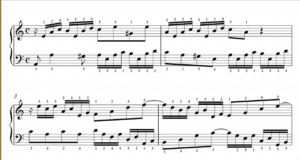
Two-voice counterpoint with scales and arpeggios: J.S. Bach’s Inventions No. 11 and 13.
-
Polyphonic fingering for three or more voices: J.S. Bach’s Sinfonia No. 3.
-
Melody accompanied by chords: J.S. Bach’s Prelude BWV 855.

-
Melody accompanied by broken chords: François Couperin’s Les Canaries.

-
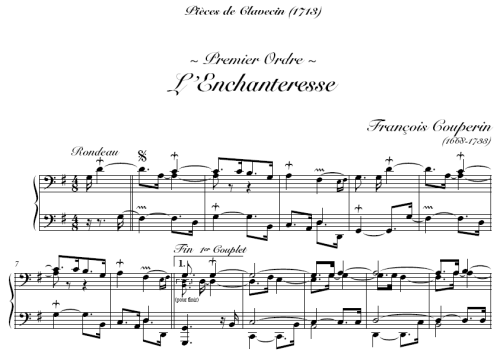
Syncopated texture: François Couperin’s L’Enchanteresse.
By isolating specific parameters this way, sight-reading stops being a frantic scramble to decipher ink on a page and becomes as natural as improvising.
I hope this gives you a good framework on how to practice it.
*Original fragment written in 2014 in portuguese, during my Bachelor in Piano Performance