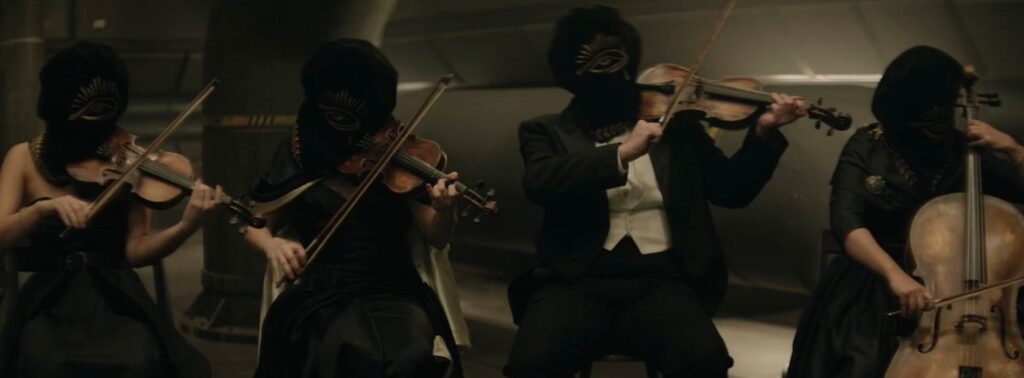
Composers frequently inquire about virtual instruments utilized for solo string quartet mockups.
Modern composition, particularly in film and media, requires significant compositional skill. The string quartet is a genre associated with strong musical sophistication and represents the seed and very birth of the the idea of an well crafted absolute concert masterpiece as we have today.
The Enduring Legacy of the String Quartet
The string quartet, typically comprising two violins, viola, and cello, solidified its form in the mid-18th century, largely through the innovations of Joseph Haydn. From its origin, this ensemble became the quintessential medium for chamber music, renowned for its transparency and intimate interplay. It swiftly evolved into a rigorous proving ground for composers, where every melodic line and harmonic progression is exposed, demanding exceptional clarity, balance, and intricate counterpoint. This inherent transparency necessitates virtuous composing, pushing creators to their highest levels of craft. Consequently, the string quartet stands as a preeminent form of musical artwork, valued for its intellectual depth and pure sonic architecture, a tradition that continues to challenge and define compositional excellence.
The most frequently cited sample libraries for this craft include:
Spitfire Audio’s Solo Strings / Chamber Strings: good for tone character.
Cinematic Studio Solo Strings:good for playability.
Vienna Symphonic Library (VSL): good for mixing flexibility.
These are amazing samples. But a core consideration for composers is that even with advanced tools, composition can be influenced by the characteristics of sample libraries and production deadlines.
Industry professionals acknowledge that while virtual instruments are technically advanced, the process of generating realistic orchestral mockups often involves efforts to mask the digital origin. This involves substantial programming to convey the nuances typically achieved by live performance. It has been observed that composers sometimes adapt their musical ideas to align with the strengths of available sample sets. This pragmatic approach navigates creative challenges by viewing inherent limitations as opportunities for inventive solutions.
“Machine-Gun” Effect & Rhythmic Monotony: Rapid repetitions with insufficient sample variations can produce mechanical, unnatural sounds.
Dynamic Flatness: Limited velocity layers or inadequate continuous controller programming may result in uniform dynamic profiles.
Homogenized Tone: Uniform samples across a section can reduce individual instrument character, impacting the organic sound of an ensemble.
Articulation Cliches: Reliance on a limited range of effective articulations within a library may lead to predictable musical phrasing.
“Canned” Sound: Overuse of pre-recorded phrases or common tropes can result in generic, unoriginal compositions.
Understanding these factors is a pragmatic aspect of composition. It involves making effective compositional choices given the available tools and time, rather than simply reproducing existing material.
The objective is to establish a balance: utilizing sample library capabilities there where they do their best while avoiding a situation where the tools limit richer compositional choices.
Despite advancements in MIDI mockups, many prominent composers consistently choose to record live string quartets or full orchestras for their final scores. This preference stems from the recognition that virtual instruments do not fully capture the organic variability, subtle breathing, spontaneous interplay, or unique sonic character that human performers contribute to music. The decision prioritizes the nuances inherent in live musical execution.
#MIDIMockup #StringQuartet #FilmComposer #MusicComposition #SampleLibraries #VST #ComposerLife #Kompositorium #Orchestration #CreativeProcess #MusicTheory #LiveRecording #MusicAsArt #Aesthetics #CompositionalVirtuosity